



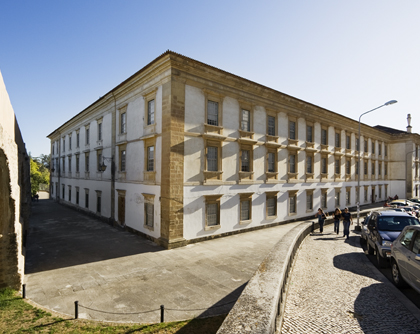
São Bento´s High school
Presentation
The College of São Bento is one of the notable religious university colleges in the city of Coimbra, founded by the Benedictines, one of the oldest monastic orders of the Catholic Church.
Located in the heart of Alta Coimbra, this historic building represents the deep connection between spirituality, knowledge, and architecture.
The Benedictine friars arrived in Coimbra in 1555 at the request of Friar Diogo de Murça, rector of the University. The building has a strong Mannerist aesthetic, with its noble façades and well-spaced windows with straight frames. The construction of the Church of the College of St. Benedict, attributed to the architect Baltazar Alves, was completed in 1634, but was destroyed in 1932 to make way for the opening of Rua do Arco da Traição. With the extinction of religious orders, the buildings were occupied by various educational institutions: Liceu D. João III / Liceu José Falcão / Liceu Nacional / Liceu D. Maria. It currently houses several departments of the Faculty of Science and Technology of the University of Coimbra.
Its architectural grandeur and academic relevance make it a landmark for those visiting Coimbra in search of living traces of its cultural heritage.
Read moreObservations
Currently, the building serves other purposes but retains its grandeur and historical significance within the city's heritage.
Particularities
The college features the sobriety typical of the Order of Saint Benedict, with a characteristic inner courtyard and austere facades that contrast with the spiritual and intellectual richness that flourished there.
Extra Information
Some parts of the building may be inaccessible to the public, depending on the current use of the space.
Aspetos Diferenciadores
The strong Benedictine tradition of organization, discipline, and study is reflected in the architectural layout and the original function of the College, making it a unique example of monastic life in a university context.
History
Founded in the 16th century, the College of São Bento was one of the centers of formation for the Benedictine Order in Coimbra. Combining religious life with higher education, the college played an important role in training the monks who contributed to the advancement of knowledge and faith.
Over time, like other colleges, it underwent various adaptations, but it remains an undeniable landmark in the city's history.